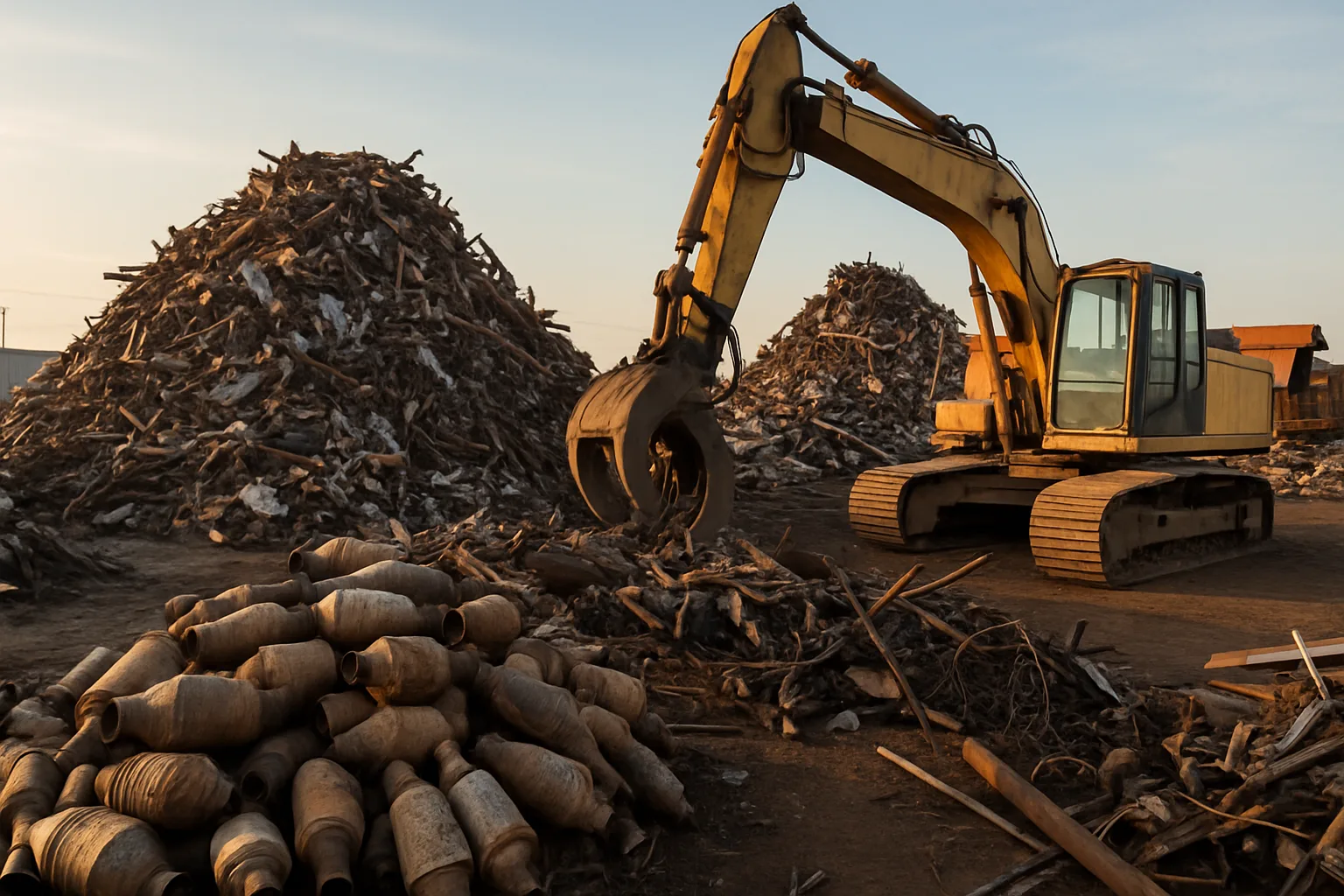
Why Your Catalytic Converter Is Worth More Than You Think — And Why Prices Change Daily
Most people know catalytic converters have value. Few people understand why — or why two converters sitting side by side on a workbench can have completely different payouts. If you're doing scrap metal recycling in Saint John and you've got cats to move, this breakdown is for you. Understanding how the pricing works puts more money in your pocket and less in someone else's.
This isn't a simple story. Catalytic converter recycling involves precious metals, global commodity markets, processor relationships, and a surprising amount of variation even within the same make and model year. Let's walk through all of it.
What's Actually Inside a Catalytic Converter
The value doesn't come from the steel shell. It comes from the ceramic or metallic substrate coated with platinum group metals — specifically platinum (Pt), palladium (Pd), and rhodium (Rh). These three metals are the reason a single converter can be worth anywhere from $20 to several hundred dollars, depending on what's inside.
Rhodium in particular is one of the most volatile commodities on the planet. It has swung from under $1,000 USD per troy ounce to over $20,000 USD in recent years. Palladium and platinum follow global industrial demand, especially from the automotive manufacturing sector. When EV production ramps up and demand for new catalytic converters falls, those prices soften. When combustion engine manufacturing surges in developing markets, they spike. You're not just selling scrap — you're touching a global commodity trade every time you move a load of cats.
- Platinum: Used heavily in diesel converters. Prices tied to European auto markets and industrial demand.
- Palladium: Dominant in gasoline converters. Highly volatile. Often the highest-value metal in a standard cat.
- Rhodium: Present in small quantities but can be the most valuable component by weight when prices are elevated.
How Catalytic Converter Recycling Actually Works — Step by Step
When a converter leaves your yard or vehicle, it starts a journey most sellers never see. Understanding that chain helps you see where value gets added — and where it can leak away if you're not paying attention.
- Collection: Converters are removed from end-of-life vehicles or sold directly by yards. This is where documentation matters — serial numbers, photos, VIN associations. Sloppy intake creates problems downstream.
- Sorting and identification: Each converter is identified by its serial number or by physical characteristics. Databases match the serial to the vehicle it came from, which tells processors what metals to expect inside. Not all processors are equally good at this step.
- Decanning: The outer shell is cut away to expose the substrate (the ceramic or metallic "brick" inside). The shell itself — usually mild steel — gets scrapped separately at standard ferrous rates.
- Milling and sampling: The substrate is crushed into a fine powder. Samples are taken at multiple points to establish the assay — the actual precious metal content per tonne of material.
- Smelting and refining: The milled material enters a smelter. Precious metals are separated and refined to sellable purity.
- Settlement: The final payout is based on the assay results, current spot prices for Pt, Pd, and Rh, and the terms of your processor contract. This can take weeks to settle if you're selling on assay terms.
Most individual sellers and smaller yards don't deal directly with smelters. They sell to intermediary buyers who aggregate loads and have direct smelter relationships. That's where platforms like SMASH Recycling — where verified buyers bid on your metal come in. Getting multiple vetted buyers competing for your load changes the dynamic. You stop guessing what the market will bear and start seeing it directly.
Why Catalytic Converter Prices Vary So Much — The Real Reasons
This is the part most sellers don't get a straight answer on. Prices vary for several compounding reasons, and understanding each one helps you avoid leaving money on the table.
1. Precious Metal Spot Prices Move Daily
Rhodium, palladium, and platinum trade on commodity markets. A shift of a few percentage points in spot price can significantly change what a converter is worth — even overnight. If you're calling one buyer and accepting a quote without knowing what spot is doing that day, you're flying blind. The copper scrap prices in Saint John and elsewhere follow the same logic: the London Metal Exchange and COMEX set the floor, and your local buyer works off a spread from there.
2. Vehicle Type and Engine Displacement Matter
A converter from a V8 truck has more substrate — and therefore more precious metal — than one from a compact four-cylinder. OEM converters generally carry higher loadings than aftermarket replacements. A salvage yard pulling cats from light trucks will consistently see different averages than one pulling from economy sedans. Serial number identification and proper cataloguing close this gap significantly.
3. Converter Condition Affects Recovery Rates
Overheated, cracked, or contaminated substrates yield less. A converter that's been rattling around loose, or one that came off a vehicle that burned oil heavily, may have a degraded ceramic core. Buyers price that risk in. Clean, intact converters with documented provenance get better offers. This is exactly why photo documentation and serial tracking matter — platforms that support detailed inventory records give buyers more confidence, which shows up in pricing.
4. Your Buyer Relationship (and Their Processor Access)
A buyer with direct smelter access passes more value back to you than a broker stacking margins in the middle. Most sellers have no idea how many hands touch their load before it hits a smelter. Competitive auction formats cut through that opacity. When verified buyers are bidding against each other on your documented load, the margin compression happens on their side — not yours.
5. Volume and Consistency
A yard moving 50 cats a week will get better terms than someone selling 10 a month. Buyers price for certainty and scale. That said, the gap between small sellers and high-volume yards narrows significantly when you bring solid documentation and access to multiple buyers simultaneously. You're not just selling a load — you're selling confidence in what that load contains.
What New Brunswick Yards and Sellers Should Know About Catalytic Converter Rules
Selling catalytic converters in New Brunswick — including in Saint John — comes with documentation obligations. Anti-theft legislation has tightened across Canadian provinces. You'll need to record seller identification, vehicle information, and the source of converters. Incomplete records can delay or kill a sale, and buyers in regulated markets won't touch undocumented material.
This isn't just a legal requirement — it's a pricing signal. Documented converters with proper BOLs, serial tracking, and source verification command better offers. Buyers absorb regulatory risk into their pricing. Take that risk off the table and they pay better. If you're working with a platform that supports serial tracking and photo documentation from the start, you're already ahead of most sellers in the region. If you're ready to see what your load is worth, sell your scrap metal in Canada on GetMyScrap and find out how much easier the process can be.
For local sellers navigating these requirements, Saint John scrap metal services are available to help you move documented loads through a compliant process.
How to Get the Best Price for Catalytic Converters and Non-Ferrous Scrap
The same principles that apply to cats apply to copper, aluminum, and other non-ferrous material. Copper scrap prices in Saint John, like everywhere in North America, are tied to global LME benchmarks. Aluminium scrap value fluctuates with automotive and construction sector demand. The gap between what a single-buyer transaction pays and what competitive bidding reveals can be significant — especially on larger loads.
Here's what moves the needle consistently:
- Document everything. Photos, weights, serial numbers, source records. Buyers price what they can't see as a risk discount.
- Know what spot is doing. Even a rough awareness of Pt, Pd, and Rh spot prices gives you a reference point when evaluating offers.
- Sell to multiple buyers at once. One call, one offer, one price. That's the old way. Competition is how you find real market value.
- Time your loads when possible. Market conditions shift. Holding a load when rhodium is trending up — if you have the storage and cash flow to do it — isn't irrational.
- Use platforms that support your workflow. Auto-invoicing, VIN lookup, packing lists, buyer vetting. Tools that reduce friction and create price competition.
SMASH is built specifically for this. No subscription fees. Vetted buyers bid on your documented loads. You get real market feedback instead of one number from one buyer who knows you don't have anywhere else to go. When you're ready to get a fair price for your scrap today, the process is straightforward — and the outcome is based on actual competition, not guesswork.
Whether you're moving a pallet of cats out of a Saint John auto salvage operation, selling copper from a commercial demo job, or clearing out aluminium extrusion from a facility in New Brunswick, the principle is the same: more buyers, better documentation, cleaner data. That's what changes the number at the end.
Want to go deeper on how scrap metal markets work and what drives prices in Canada? Explore Canadian scrap metal guides for practical breakdowns across metals and regions.
Frequently Asked Questions
Q: How do I know what my catalytic converter is worth before selling?
The best starting point is the serial number stamped on the converter. Processor databases and serial lookup tools can give you an estimated precious metal loading for that specific unit. Cross-reference that against current Pt, Pd, and Rh spot prices for a rough value range. Keep in mind that condition, buyer margins, and processing terms all affect the final number — which is why selling into a competitive format gives you better price discovery than a single quote.
Q: Do I need ID or paperwork to sell catalytic converters in Saint John?
Yes. New Brunswick, like most Canadian provinces, requires sellers to provide identification and documentation of where the converter came from. Dealers and buyers are required to record this information. Proper documentation also protects you and signals to buyers that your material is clean and traceable — which typically means better offers.
Q: Why do copper scrap prices change so frequently in Saint John?
Copper is a globally traded commodity priced on the London Metal Exchange (LME) and COMEX. Prices shift daily based on supply and demand signals from manufacturing, construction, and energy sectors worldwide. Local buyers in Saint John work off a spread from those benchmark prices. Checking current spot copper prices before you sell helps you evaluate whether an offer is fair.
Q: Is it better to sell catalytic converters locally or through an online platform?
It depends on volume, documentation, and how much competition you can access. Local buyers are convenient, but a single local quote is still just one data point. Online platforms that connect you to multiple vetted buyers — like SMASH — create competitive pressure that often reveals prices local single-buyer transactions don't. For high-value or high-volume loads, the difference can be meaningful.
Q: What other scrap metals get the best prices in New Brunswick right now?
Copper consistently commands premium pricing relative to weight, followed by certain aluminum alloys (particularly 6061 and cast aluminum). Catalytic converters can outperform both on a per-unit basis when precious metal prices are elevated. Prices fluctuate — always check current rates before selling. A platform with active buyer competition gives you the most accurate read on what the market is actually paying on a given day.
Prices for catalytic converters, copper, aluminum, and all scrap metals fluctuate based on global commodity markets. Always verify current rates before selling. Nothing in this article constitutes a price guarantee or market prediction.
Stay current on scrap metal market trends and industry news — follow SMASH on LinkedIn for regular updates, pricing insights, and practical guides for Canadian scrap sellers and buyers.