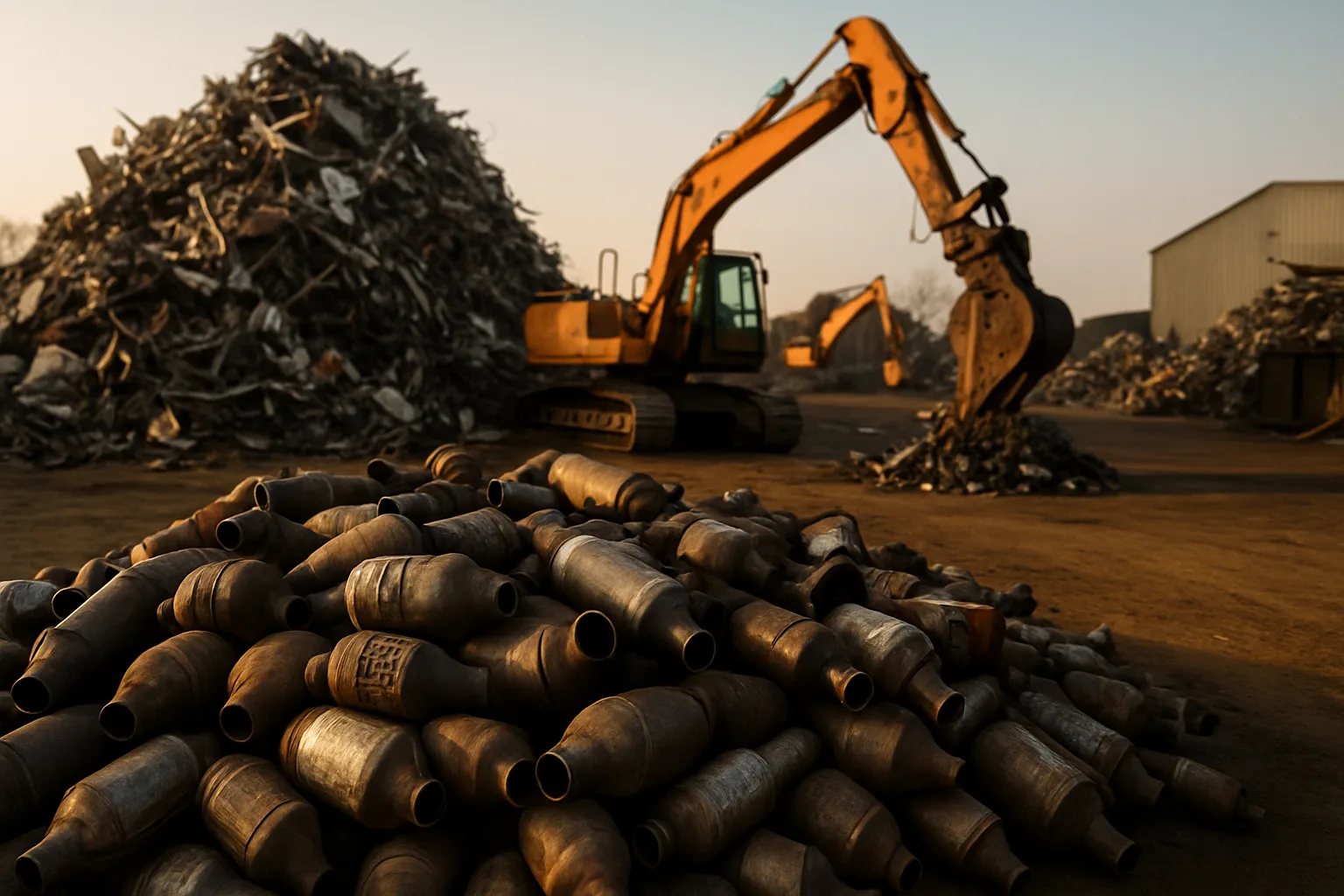
Why Your Catalytic Converter Is Worth More Than You Think — And Why the Price Keeps Changing
Most people know a catalytic converter has value. Few understand why — or why the guy down the street got a different price than you did for the same part. If you're trying to make sense of scrap metal prices today and figure out what your cat is actually worth, this guide breaks it down straight.
Catalytic converters are one of the most misunderstood items in the scrap world. They look like a plain metal canister. Inside, they hold platinum, palladium, and rhodium — three precious metals that drive the recycling industry and make cats one of the highest-value items you can bring to a yard. Understanding how that value gets calculated is the difference between leaving money on the table and getting paid what your load is actually worth.
What's Actually Inside a Catalytic Converter
The value isn't in the steel shell. It's in the ceramic or metallic substrate inside — a honeycomb structure coated with platinum group metals (PGMs): platinum, palladium, and rhodium. These metals are critical for industrial processes, electronics, and vehicle manufacturing. Recyclers extract them through a smelting and refining process called assaying.
Here's why this matters for pricing:
- Platinum — Used in diesel cats. Price volatile but consistently high.
- Palladium — Dominant in gasoline engine cats. Has seen extreme price swings over the past several years.
- Rhodium — The rarest of the three. Even small concentrations drive up converter value significantly.
The exact PGM content varies by vehicle make, model, year, and engine type. A cat from a late-model Toyota SUV contains a different ratio of metals than one from a domestic pickup truck or a European diesel. That's why serial tracking and VIN lookup aren't just tech features — they're how buyers actually price what they're buying. Platforms like SMASH use serial tracking and documented inventory so buyers know exactly what they're bidding on, which leads to more accurate pricing and better outcomes for sellers.
Why Scrap Metal Prices Today Fluctuate — Especially for Cats
If you've checked scrap metal prices today and compared them to last month, you may have noticed the swings. Catalytic converter prices are more volatile than most scrap categories because they're tied directly to commodity markets for platinum, palladium, and rhodium — metals traded globally. A policy shift in South Africa (which produces most of the world's PGMs), a change in vehicle emissions standards, or a surge in EV adoption can all move the needle.
In 2026, the market continues to reflect a few key pressures:
- Stricter emissions regulations in North America and Europe are increasing PGM demand from manufacturers — which keeps recycled PGMs valuable.
- EV growth is reducing the long-term supply of spent converters, making existing supply more competitive among refiners.
- Supply chain instability for virgin PGMs keeps recycled material relevant and in demand.
None of this means your cat's value goes up every week. It means the price is real and market-driven, not made up by whoever happens to answer the phone at your local yard. That's exactly why a competitive auction format — rather than a single buyer quoting you a number — tends to produce better price discovery. More buyers means better price discovery. That's not a sales pitch. That's just how markets work.
Disclaimer: Catalytic converter and scrap metal prices fluctuate daily based on global commodity markets. Always check current rates before selling.
How Catalytic Converter Recycling Works — Step by Step
Most sellers hand over a cat and walk away with cash. What happens next is a multi-step process that determines whether the buyer made money, lost money, or broke even. Understanding it helps you negotiate smarter.
- Collection and sorting — Converters are sorted by type: foil (metallic substrate), ceramic (honeycomb), and bead (older designs). Each type has different PGM concentrations.
- Decanning — The substrate is separated from the steel shell. The steel goes to ferrous scrap. The substrate goes to a processor.
- Sampling and assaying — A batch of substrates is crushed, sampled, and tested for PGM content. This process tells the refiner exactly how much platinum, palladium, and rhodium they're working with.
- Smelting and refining — The PGMs are extracted through high-temperature processing. This takes time — typically weeks from delivery to settlement.
- Settlement — The refiner pays the processor based on the assay results and the current market price of each metal on the day of settlement.
The gap between what you get paid at the yard and what the refiner eventually recovers is the processor's margin. That margin gets tighter when there's more competition for your load. If you're a yard in Cambridge or elsewhere in Ontario selling a pallet of cats, putting that load in front of multiple vetted buyers through a catalytic converter auction is how you close that gap.
What Affects the Price You're Actually Quoted
Two yards in the same city can quote you a different number for the same converter. Here's why that's not necessarily dishonest — and why it still pays to shop around.
Serial number and make/model identification: Buyers use databases that map converter serials to known PGM content. If your serial is readable and the converter is a known, high-value unit, you get a better quote. If the serial is missing or the unit is unidentified, buyers price conservatively. This is why photo documentation and serial tracking at the time of listing matters — it protects you from lowball estimates based on uncertainty.
Volume and consistency: A single converter and a pallet of 50 are priced differently. Buyers who know they're getting consistent volume are more willing to bid aggressively.
Who's quoting you: A buyer with direct access to a refinery quotes differently than a broker buying speculatively. Vetted buyers on platforms like SMASH compete for loads because they have real downstream relationships — not because they're guessing.
Market timing: Palladium and rhodium prices on the day you sell directly affect what a buyer can offer. Selling into a rising market versus a down week can move your number meaningfully.
If you're in Cambridge and selling converters regularly, building a relationship with a platform that brings competition to your door is worth more than any single quote from any single buyer. You can learn more about Cambridge scrap metal services specific to your area to understand what options are available locally.
Selling Cats and Scrap Metal in Cambridge and Ontario — What to Know
Cambridge sits in the heart of Ontario's industrial corridor. Yards here handle everything from catalytic converters to non-ferrous metals — copper, aluminum, and stainless. If you're looking to sell your scrap metal in Canada on GetMyScrap, you're already in a region with strong buyer demand and decent yard competition. But decent isn't the same as optimal.
The old way of selling — call one buyer, take their number, done — leaves you with no reference point. You don't know if the quote you got is 10% below market or 30% below market. You just know what you got paid. That's a significant problem when you're moving volume.
Scrap metal recycling in Ontario is also subject to provincial regulations around documentation — especially for converters, which have been a theft target. Keeping proper records, photos, and chain-of-custody documentation isn't just good business. In some cases, it's required. Platforms that build documentation into the workflow make compliance easier and loads more credible to serious buyers.
Beyond cats, if you're also moving aluminum or copper alongside your converters, it's worth knowing that aluminum scrap value per pound and copper pricing follow similar commodity logic — global demand, exchange pricing, local supply. Bundling your loads with complete documentation and putting them in front of competitive buyers applies across every category of non-ferrous metal.
How SMASH Makes the Catalytic Converter Market Work for Sellers
SMASH is built specifically for this. Yard operators and sellers list their loads — converters, non-ferrous metals, cores — with photos, serial numbers, and documented inventory. Vetted buyers across North America bid in a competitive auction format. The seller sees real market demand, not a single buyer's take-it-or-leave-it number.
No subscription fees. SMASH only wins when the seller wins. The platform handles auto-invoicing, documentation, and buyer vetting so you're not doing administrative work on top of yard work.
If you want to see what competition actually does to your price discovery, find the best price for your scrap in Canada and put a load in front of buyers who have to compete for it. That's the difference between guessing your price and knowing it.
Whether you're clearing out a few cats from a recent vehicle teardown or you're a Cambridge yard moving converter pallets weekly, the process is the same: document what you have, list it where buyers compete, and let the market tell you what it's worth. If you want to get a fair price for your scrap today, the tools are there — you just have to use them. Explore Canadian scrap metal guides for more on how to maximize value across every category.
Getting paid fairly for your scrap metal — whether it's a catalytic converter, a load of aluminum, or a pile of mixed non-ferrous — starts with knowing what you have and who's buying it. GetMyScrap makes it easy to connect with the right buyers and get the process started. Request a pickup at getmyscrap.ca and stop leaving money on the table.
Frequently Asked Questions
Q: Why do catalytic converter prices vary so much from yard to yard?
Converter prices are based on the platinum group metals inside — platinum, palladium, and rhodium. Each buyer has their own refinery relationships, margin targets, and market timing. A buyer quoting conservatively may simply have less competitive downstream access. Getting multiple quotes, or listing through a competitive auction, gives you a real market reference point instead of one buyer's number.
Q: What are scrap metal prices today for catalytic converters in Cambridge?
Catalytic converter prices change daily based on global PGM commodity markets. There's no single posted price — value depends on the converter's make, model, serial number, and current palladium and rhodium spot prices. Check current rates with local Cambridge yards or list through a platform like SMASH to see competitive bids. Always verify current pricing before selling — rates fluctuate.
Q: How do I know if my catalytic converter serial number is readable?
Look for a stamped or etched code on the outside of the converter body, typically near the inlet or outlet pipe. If it's corroded or worn off, a buyer may still be able to identify the unit by vehicle VIN and production date. Platforms with VIN lookup tools can help match your converter to known PGM content even without a readable serial.
Q: Is it legal to sell catalytic converters in Ontario?
Yes, selling used catalytic converters is legal in Ontario, but regulations require documentation of ownership and source to combat converter theft. Keep records of the vehicle the converter came from, including make, model, VIN, and your identity as the seller. Yards and platforms that build documentation into their process make this compliance straightforward.
Q: What other scrap metals can I sell alongside catalytic converters in Cambridge?
Cambridge yards and platforms like SMASH accept a full range of non-ferrous metals — copper, aluminum, stainless steel, and more. Aluminum scrap value per pound and copper pricing follow similar commodity logic to PGMs. Bundling your loads and listing them with proper documentation gives buyers more confidence and can improve price discovery across every category.
Stay current on scrap metal market trends and industry insights — follow SMASH on LinkedIn for regular updates from inside the recycling industry.