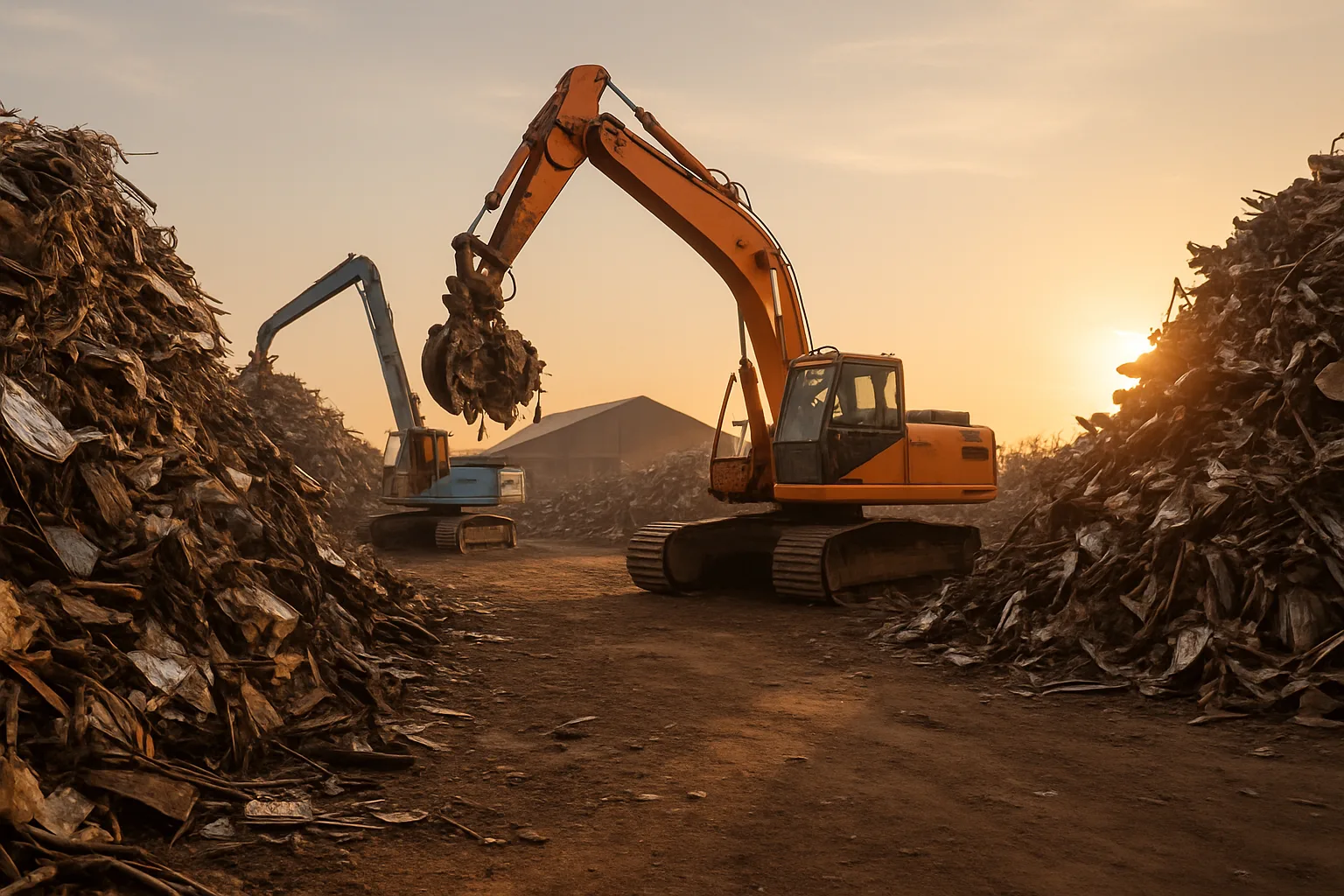
Why Scrap Metal Prices Today Are Never the Same as Yesterday
You checked the price of copper last Tuesday. Today it's different. That's not a glitch — that's how scrap metal markets work. Scrap metal prices today move with global commodity exchanges, currency shifts, and demand signals that change by the hour. If you're planning to sell scrap metal and you're working off a price you heard two weeks ago, you're almost certainly leaving money on the table.
This guide breaks down exactly why prices fluctuate, what drives them, and how to time your sale smarter — whether you're clearing copper wire from a job site in Barrie or moving a pallet of aluminum extrusion from a shop floor in Ontario.
What Actually Drives Scrap Metal Prices Day to Day
Scrap metal isn't priced in a vacuum. Every yard, broker, and platform pulls from the same upstream signals — and those signals are constantly moving. Understanding what pushes prices up or down gives you real leverage as a seller.
Here are the main drivers:
- London Metal Exchange (LME) and COMEX spot prices — Copper, aluminum, and nickel are traded on international exchanges. When spot prices rise, scrap values follow. When they drop, so does what your yard will pay.
- USD/CAD exchange rate — A lot of scrap sold in Canada gets exported or benchmarked against U.S. pricing. When the Canadian dollar weakens, CAD-denominated scrap prices often increase. When the loonie strengthens, it can compress local payouts.
- Domestic demand from mills and foundries — Steel mills and aluminum smelters buy scrap to feed production. If a major mill goes offline for maintenance or ramps up, it shifts the entire supply-demand balance regionally.
- Fuel and freight costs — Moving scrap is expensive. When diesel prices climb, yards tighten margins on what they pay per pound. Logistics costs are baked into every price quote.
- Seasonal scrap volumes — Construction activity peaks in summer across Ontario. More copper pipe, wire, and aluminum framing hits the market. Higher supply can soften prices per pound even when demand holds steady.
- Geopolitical events and trade policy — Tariff changes, trade disputes, and sanctions on metal-producing countries can send commodity prices swinging within a single trading session.
No single factor controls scrap metal prices today. It's always a combination. That's why checking prices from a single buyer once a week and assuming they're stable is a losing strategy.
Breaking Down Price Fluctuations by Metal Type
Not every metal moves the same way. Copper is the most volatile. Aluminum is more stable but still shifts. Steel and iron move slowly but in larger volume swings. Knowing which metal you're selling — and how it typically behaves — changes how you approach timing.
Copper
Copper is the most globally traded industrial metal. It's used in electrical systems, plumbing, HVAC, and electric vehicles. Demand from EV manufacturing and grid infrastructure projects has kept copper prices elevated through the mid-2020s. Scrap copper — bare bright, #1, #2 — each grade carries its own price, and the spread between grades matters. A load of bare bright wire pays meaningfully more per pound than insulated wire or mixed copper. Knowing your grades before you sell isn't optional — it's money.
Aluminum
Aluminum scrap value per pound is lower than copper, but aluminum shows up in higher volumes — siding, wheels, extrusions, cans, castings. The gap between clean aluminum and contaminated or mixed loads is significant. Buyers discount heavily for painted, coated, or dirty material. Sorting before you sell pays off. Aluminum also tracks global production costs closely — when energy prices spike (aluminum smelting is energy-intensive), scrap values often firm up as mills prefer recycled feed over primary production.
Catalytic Converters
Cats are the most complex scrap category. Their value comes from platinum group metals (PGMs) — platinum, palladium, and rhodium — locked inside the ceramic substrate. PGM prices swing hard. A catalytic converter worth a certain amount one month can be worth significantly more or less the next, depending on palladium market conditions. This is exactly why a catalytic converter auction model outperforms a simple yard quote. When multiple vetted buyers compete on a documented lot of cats, price discovery actually reflects the real market. Platforms like SMASH Recycling — where verified buyers bid on your metal are built specifically for this kind of complex, high-value scrap category.
Steel and Iron
Ferrous metals — prepared steel, cast iron, shredded — move in larger quantities but at lower per-pound values. Steel pricing tracks domestic mill demand closely. When North American construction and manufacturing are strong, mill demand for scrap iron rises and prices firm. Ferrous scrap is also the most logistically demanding: you need volume to make the haul worthwhile. Small quantities of steel rarely justify sorting effort unless you're already consolidating a larger load.
Why Selling to One Buyer Is a Price Discovery Problem
Here's the old way: you call your regular yard, they give you a price, you either take it or leave it. You have no idea if that price reflects the real market or if it's been held down because there's no competition in the conversation. Most sellers in Ontario and across Canada are operating exactly this way right now.
The problem isn't that yards are dishonest. The problem is structural. A single buyer has no incentive to tell you the market is up. And without competing bids, you can't verify it either. That information asymmetry is a permanent feature of the one-call, one-buyer system.
More buyers means better price discovery. That's not marketing language — it's basic market mechanics. When five vetted buyers see the same documented load and compete on it, the resulting price reflects actual demand. You're not guessing. You're not trusting one party to tell you what your metal is worth.
This is the core of how SMASH scrap works. Sellers document their loads — photos, weights, grades, serial numbers where applicable — and vetted buyers bid competitively. Whether you're moving non-ferrous loads out of Barrie or clearing industrial scrap from a facility in the GTA, competition can help reveal the market. That's a fundamentally different experience than a single phone call and a hope.
If you want to sell your scrap metal in Canada on GetMyScrap and stop guessing what your load is actually worth, the difference is documented inventory and competitive bidding — not wishful thinking.
How to Time Your Scrap Metal Sale in a Volatile Market
You can't time the market perfectly. Nobody can. But you can be smarter about when and how you sell — especially for high-value non-ferrous material like copper and cats.
Here's a practical approach:
- Track spot prices weekly, not monthly. LME copper and aluminum prices are publicly available. Even a rough directional sense of whether prices are trending up or down changes your decision-making.
- Don't hold scrap indefinitely waiting for a spike. Storage has costs — space, security, insurance. Unless you have a specific reason to believe prices are rising, holding too long often costs more than it gains.
- Separate and sort before selling. Mixed loads get discounted. Clean, sorted scrap — copper by grade, aluminum by alloy type, cats by series — commands better pricing from buyers who know exactly what they're getting.
- Document your load properly. Photos, weights, and condition descriptions give buyers confidence to bid higher. Uncertainty gets priced in as a discount. Documentation removes uncertainty.
- Get multiple quotes or use an auction format. For high-value loads, a single quote is a starting point, not a final answer. Competitive bidding on documented material gives you the real number.
- Sell smarter on cats specifically. Catalytic converters should almost never be sold in bulk to the first buyer who calls. PGM content varies by make, model, and year. A platform built for cat auctions — with VIN lookup, photo documentation, and serial tracking — protects your value.
Yards around Barrie and across scrap metal recycling Ontario markets see the same metals every day. The sellers who get better outcomes aren't necessarily working harder — they're just working with better information and more buyer competition.
Sell Smarter: What Documentation Does for Your Price
One of the most underestimated tools in scrap selling is documentation. Most sellers treat it as paperwork. It's actually a pricing lever.
When a buyer looks at a load with clear photos, accurate weights, sorted grades, and a detailed packing list, they can bid with confidence. Confidence reduces the risk discount they'd otherwise build into their offer. A well-documented load of #1 copper wire gets bid differently than a photo that shows a tangled pile of "misc wire." Same metal, different price.
SMASH's platform is built around this principle. Inventory tools, photo documentation, VIN lookup for catalytic converters, serial tracking — all of it exists to give buyers the information they need to bid confidently and competitively. Auto-invoicing and BOL generation mean the admin side doesn't slow the deal down either.
If you're ready to get a fair price for your scrap today, start by knowing what you have, documenting it properly, and putting it in front of more than one buyer. That's the whole game.
For more on how to navigate scrap categories, pricing trends, and selling strategies in Canada, explore Canadian scrap metal guides on the GetMyScrap blog.
Ready to stop guessing and start selling with real market data behind you? Request a pickup and get a fair price for your scrap metal in Canada at getmyscrap.ca — or check out Barrie scrap metal services if you're local to the area.
Stay current on scrap metal market movements and industry news by following SMASH on LinkedIn — practical updates for recycling yards and sellers across North America.
Frequently Asked Questions
Q: Why do scrap metal prices today change so frequently?
Scrap metal prices track international commodity exchanges like the LME and COMEX, which update continuously during trading hours. Currency fluctuations, industrial demand, freight costs, and geopolitical events all feed into daily price changes. Checking prices weekly — or using a platform that reflects live market bids — is far more reliable than relying on a number you heard last month.
Q: How do I find the best place to sell scrap metal near me in Barrie?
Start by sorting and documenting your material, then get quotes from more than one buyer. For higher-value non-ferrous scrap like copper or catalytic converters, a competitive auction format will typically reveal better pricing than a single yard quote. Platforms like SMASH connect sellers with vetted buyers across Ontario and beyond, so geography doesn't limit your options.
Q: What is aluminum scrap value per pound in Canada right now?
Aluminum scrap prices vary by grade, contamination level, and current market conditions. Clean extrusion, cast aluminum, and sheet all carry different values per pound. Prices shift with LME aluminum spot rates and the CAD/USD exchange rate. Always check current rates directly with buyers or platforms, as published prices can be outdated quickly. Prices fluctuate — always verify current rates before selling.
Q: Are catalytic converter auctions worth it compared to selling to a local yard?
For most sellers moving more than a handful of cats, yes — significantly. Catalytic converter values depend on PGM content, which varies by vehicle make, model, and converter series. A yard quote is one data point. An auction with multiple vetted buyers bidding on documented, photo-verified converters is actual price discovery. The difference in outcome can be substantial, especially when palladium and rhodium markets are active.
Q: Does scrap metal recycling in Ontario follow the same prices as the U.S.?
Ontario scrap prices are benchmarked against international commodity markets, but local factors — the CAD/USD exchange rate, regional mill demand, and transportation costs — create differences from U.S. yard prices. Scrap metal recycling in Ontario also operates under provincial regulations around documentation and dealer licensing, which affect how yards operate and what information they're required to collect on transactions.